
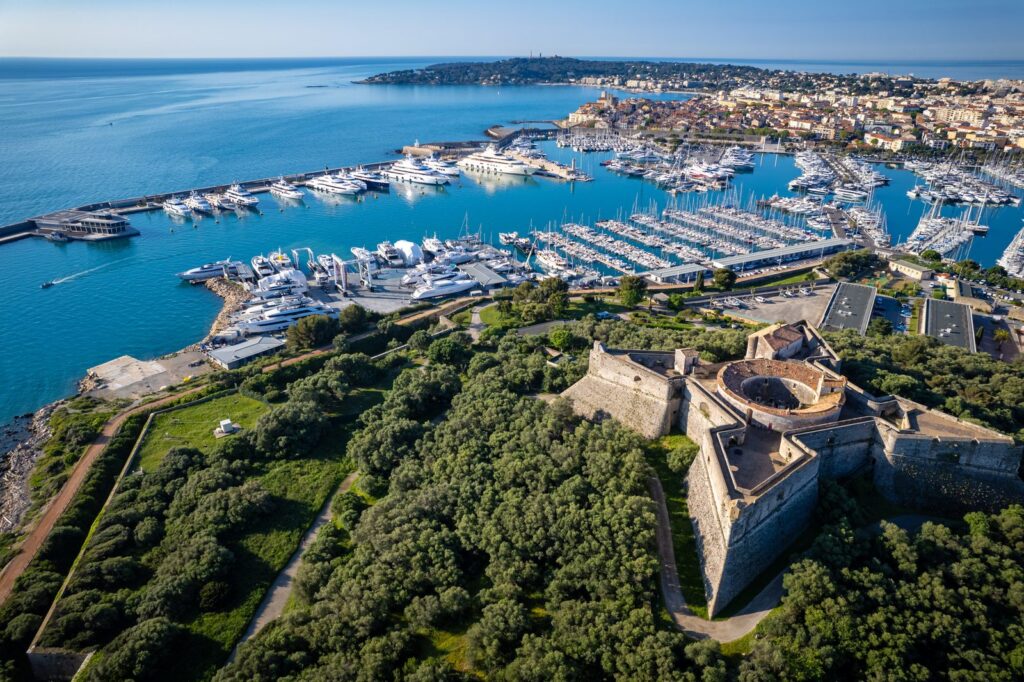
Walk along the Quai des Milliardaires in Antibes on a summer morning and you are looking at some of the most valuable movable objects ever built. Port Vauban, one of the largest marinas in the Mediterranean, holds hundreds of millions of euros of naval engineering within a few hundred metres of quay. A little further east, the harbour of Monaco does the same in an even smaller space. Between these two points lies the densest concentration of superyachts in the world.
And yet, for all their value, these vessels share a quiet secret that every experienced owner already knows: a yacht is a temporary thing.
I do not mean this unkindly. I mean it as a matter of fact. A superyacht is refitted every few years. Interiors are stripped out and reimagined. Hulls change hands, change names, change flags. The boat that carries your family today will, in all likelihood, carry another family under another name within a decade or two. This is not a flaw. It is simply the life cycle of a vessel that lives hard, in salt and sun and motion.
So here is the question I put to the owners, the brokers and the naval architects I meet along this coast: when everything on board is designed to be replaced, what, if anything, is designed to last?
The one element that outlives the vessel
At MosArtek we create artistic mosaics, cut and laid by hand, tile by tile. It is the slowest of the arts, and we are proud of its slowness. It is also, by some distance, the most durable art form humanity has ever produced.
Consider the evidence. In Switzerland, where our atelier worked for many years, archaeologists have catalogued around 410 Roman floor mosaics, made between the end of the first century BC and the fourth century AD. Some of them are more than two thousand years old. They have survived earthquakes, fires, floods, looting and two millennia of neglect, and they are still legible today. No painting, no fresco, no lacquered panel and no piece of furniture from that period has survived in anything like the same condition.
A mosaic made of stone and glass is not decoration in the ordinary sense. The material itself is bound up with the existence of the universe. Stone is the earth’s own gift, formed over unimaginable spans of time. Glass is silica, born of sand, and silicon is one of the oldest elements there is. When you commission a mosaic, you are working with matter that predates humanity and may well outlast it.
For a superyacht owner, this changes the conversation entirely. The vessel will be refitted. The mosaic will not. It becomes the one permanent element in a life built largely from things that move, change and are eventually let go.
Salt, motion and time: the only truly marine-grade art
There is a technical reason, too, why the mosaic belongs at sea, and it is one that naval architects understand immediately once it is explained.
The marine environment is merciless. Salt, ultraviolet light, vibration and constant thermal shock destroy most materials over time. A canvas will not survive it. A fresco will not survive it. Even fine joinery must be nursed, refinished and eventually replaced. For years I have heard the same objection, first from builders in the cold Swiss climate and later from those who assumed the open sea would be worse: a mosaic, they said, cannot survive outdoors.
It is not true, and my own work is the proof. Throughout my professional life I have made mosaics for demanding outdoor settings, and I have never encountered the failures I was warned about. Those works are still in place, and still in excellent condition.
The secret is not luck. It is the choice of the right materials and the right technique. A mosaic fails outdoors only when someone uses excessively porous tiles, mortars that are not technologically advanced, or execution methods that are simply not suited to the setting. Choose non-porous tesserae, the correct advanced mortars and a proper method of laying, and the work will resist salt, movement and time as few things on board ever could. This is why I say, without exaggeration, that the mosaic is the only genuinely marine-grade permanent art. It is not merely an aesthetic choice; it is a technical specification.
A surface that lives with the light
There is also a reason a mosaic feels so at home on the water, and it has to do with light. An artistic mosaic is not a flat, printed surface. Each tessera is cut by hand with a hammer and hardie, the same steel tools the ancients used, and each cut leaves a face that is very slightly irregular. That irregularity is the whole point. Where an industrial tile is milled flat and reflects light in one dull, uniform sheet, a hand-cut tessera catches the light and scatters it, so the surface seems to breathe and move as you pass. The glass tesserae we use, the smalti, are still produced by hand in a handful of furnaces, mostly in the north-east of Italy, from closely guarded formulas of silica, oxides and stabilisers. Set beside gold leaf, they give a depth and a play of reflection that no synthetic material can imitate.
On board, where the sea is never still and the light changes hour by hour, this living quality is extraordinary. A mosaic in a stateroom, a spa or a beach club does not simply sit on the wall. It answers the water outside. It is, in the most precise sense, alive with the same light that surrounds the vessel.
Your art can move, even when the vessel cannot
There is one objection I hear more than any other, and it deserves a direct answer. If a mosaic is so permanent, is it not also a prisoner of the vessel? What happens when the yacht is sold, or scrapped, or refitted beyond recognition?
The answer is reassuring. Your boat and your villa are not immortal. Your mosaic is. A mosaic can be detached, transported and relaid in a new location. The identity you commissioned does not go down with the ship, and it does not vanish in the refit. It can follow you from a yacht to a residence, from one home to the next, carrying its meaning intact across the moves of a lifetime and beyond.
This single fact reframes the whole idea of permanent art at sea. It is not a fixture you abandon when circumstances change. It is a portable inheritance.
Why the Riviera, and why now
Our own story has followed that appetite. We opened the atelier in Italy in 2000, and for the years that followed it was based in Switzerland, where I learnt just how deeply the international luxury market loves genuine Italian art. The further I worked from Italy, the clearer that appetite became. So in October 2025 we did the only natural thing: we brought the atelier here, to Antibes, into the very heart of the market I have been describing.
The Côte d’Azur is where that appetite gathers on the water. Antibes and Monaco are not merely beautiful places to keep a boat; they are a natural meeting point for owners, brokers, captains, yacht designers and the family offices that stand behind them. It is a community that already understands rarity, provenance and the difference between something bought and something commissioned.
That distinction matters. To own an artistic mosaic has always been a privilege reserved for a few. The Roman patricians knew it well: to commission the finest craftsmen to build an exclusive mosaic was expensive, and it was an unmistakable sign of standing. The richer the mosaic in detail and colour, the more powerful its owner. This was true in antiquity and it is true now. It is a slow and precious art, and not everyone can have access to it.
A superyacht is already a statement of who you are. The mosaic is the signature beneath it. It says that among all the beautiful things you have gathered, one was made by hand, for you, to last not a season but centuries.
The most enduring investment on the water
So when I say that superyacht owners are looking ashore for their most enduring investment, I mean it quite literally. The vessel is the adventure. The mosaic is the legacy. One is designed to be lived hard and eventually handed on. The other is designed to survive every refit, every sale, every change of name, and to be relaid wherever life takes it next.
From Port Vauban to Monaco, that is a conversation worth having, and one that too few owners have ever been offered. If you build, design or advise on the great vessels of this coast, I would be glad to have it with you.
Silvia Jencinella
Creative Director and CEO, MosArtek, Maison d’Art de Création de Mosaïque Italienne
Image: Mike Workman/stock.adobe.com