
There is an object, in certain houses, that an adviser struggles to classify.
It is not an investment in the strict sense, because it is not bought to be resold. It is not a mere furnishing, because it is worth too much and lasts too long.
It is a permanent work of art, a mosaic on a wall, a floor, the bottom of a pool, and it sits in a border zone between two categories we usually keep well apart: the asset and the heirloom.
I write for Wealth Managers, for Private Bankers, for those who advise a family on what to do with its wealth.
Because when a client tells you they are thinking of an important work for their residence, the question they will put to you, sooner or later, is exactly this: is it an asset or a memory? The honest answer is that it is both, and it is worth understanding why.
What distinguishes an asset from an heirloom
An asset is something that has a value and that, in principle, can be realised: it is valued, it is insured, one day it can be sold.
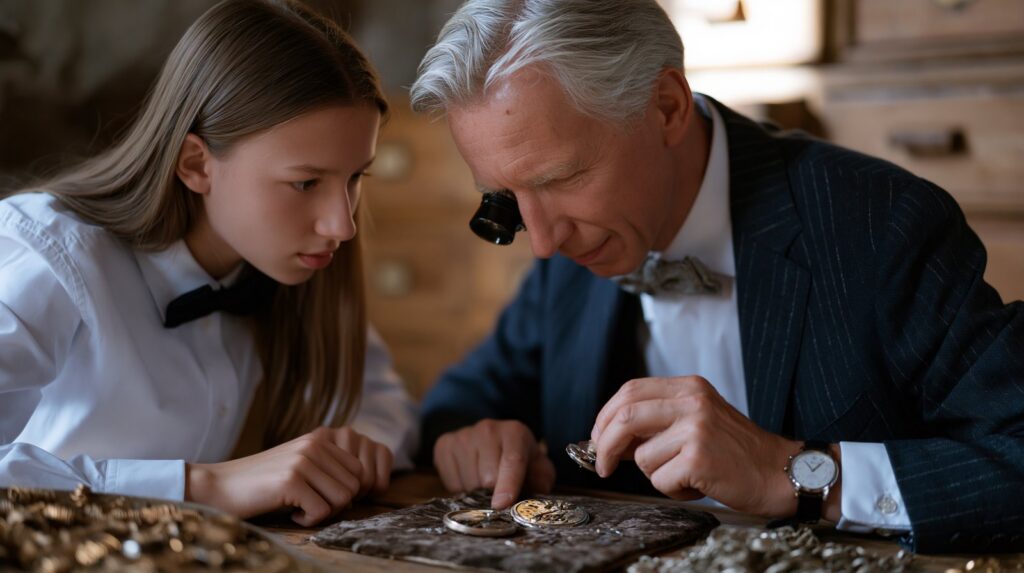
An heirloom is almost the opposite: it is something kept precisely because it is not sold. Its value lies not in the price, but in continuity, in the story it carries and the hands it passes to.
Most of a family’s objects sit comfortably on one side or the other: a portfolio of securities is an asset; grandfather’s watch is an heirloom.
A permanent work of art, instead, sits uncomfortably in between. An artistic mosaic has a real, documentable value like an asset, and it lives in the house and in the family like an heirloom.
To ignore either of the two natures means advising the client badly.
The clear, honest point a good adviser makes first
I begin with what a serious adviser should put on the table at once, and what I myself tell clients: a mosaic integrated into a residence is not a speculative investment.
I am not a financial adviser, and I do not promise appreciation. Anyone who promises it to you, on a work bound to a place, is not credible.
A permanent mosaic is not a painting you take off the wall and send to auction. When it is conceived as part of the place, that is where it lives.
Its nature as an asset is not that of a liquid, tradable good: it is that of a kept value, one that neither wears away nor evaporates, but that cannot be turned into money with a click either.
Saying this clearly to the client does not weaken the proposal, it strengthens it.
Because it moves the conversation from the wrong ground, “how much will it yield?”, to the right one: “what will remain?”.
The return a permanent work truly offers
If the return is not resale, what is it? It is another, and for some families it is worth more.
- It is permanence: while almost every other expense in a house is, sooner or later, redone and goes back to being a cost, a well-made work remains and is not repeated.
- It is identity: the work gives the place a recognisable signature, one that no one else owns and that no one can replicate.
- It is transmission: it is something children and grandchildren will receive intact, with the story of its making attached.
A permanent work converts a part of spending, which would have evaporated, into a value that remains. It is not an investment that yields: it is an expense that is not lost into nothing.
For an adviser, this is a precious distinction to be able to explain. You are not promising a gain, you are pointing out the only way – in a residential project – to turn a share of the budget into patrimony rather than into pure consumption.
What makes a work a true heirloom
On the other nature, that of the heirloom, it is worth being precise, because it is the one that touches the client most.
What makes an object an heirloom is not the price, it is the story and the continuity.
An heirloom is such because someone chose it, because it carries a story, because it passes from generation to generation without interruption.
A commissioned work is born already with all this. The family does not find it on a market: it brings it into being, chooses the subject, the materials, the place, and follows its making.
In the end, it owns not only the work, but its entire story: who conceived it, by which hands it was made, why it is exactly there.
A bought heirloom is an object with someone else’s story. A commissioned heirloom is an object with your family’s story, from the first day.
It is a difference that clients feel, even when they cannot put it into words, and that an attentive adviser can help them bring into focus.
An example of how the two natures coexist
Let us imagine a family that commissions a large mosaic for the entrance wall of its residence.
- On the asset side, that work must be documented: authenticity, materials, technique, a valuation the adviser can use in the overall picture of the patrimony and in the insurance cover; it is a real position, not a figure of speech.
- On the heirloom side, that same work is the first thing anyone entering the house sees, and it will be the first thing the grandchildren see when the house is theirs. It carries the subject the family chose, perhaps tied to its history, to its place of origin, to an idea of itself.
The two natures do not compete for the work: they inhabit it together, and both exist only because, at the start, someone thought of both.
And if one day the family had to part with it?
It is a question a good adviser asks, and to which one must answer honestly.
A work integrated into a property normally transfers with the property: whoever buys the house also acquires the work that is part of it.
📌 A concrete example we have dealt with first-hand: see note at the foot of the page ⬇️
A work conceived from the start as detachable, instead, can follow the family elsewhere.
An integrated mosaic can hardly be dismantled and sold separately like a painting – except at the cost of serious damage, as I have already written in the article Art as a Legacy ➡️ A brief technical note – and it is right that the client should know this before, not after.
If, for a family, the possibility of separating the work from the house matters, that choice must be made at the design stage, with a substrate designed for removal.
An heirloom makes sense only if it survives
There is a detail that those who think in terms of transmission tend to take for granted, and that is not to be taken for granted: for a work to be truly an heirloom, it must reach intact the generation meant to receive it.
Many art forms do not reach it; many decorative materials give way within a few decades.
An artistic mosaic, made with first-choice materials and with the right technique, is among the very few works that cross the centuries without losing themselves: the floors and walls we admire two thousand years on prove it.
It is not some convenient marketing “gimmick” of mine, it is the reason this technique still holds the primacy in ultra-luxury decoration.
An heirloom that degrades too soon is not an heirloom worth the name: it is a problem one inherits. The mosaic is one of the few works the grandchildren will receive as the grandparents wanted it.
For an adviser, this closes the circle: the very durability that makes the work an asset that does not wear away is what allows it to function as an heirloom across the generations.
The two natures, in the end, rest on the same reality.
The two natures are not in conflict: they are designed together
Here is the practical point, the one on which you can truly make a difference.
The asset nature and the heirloom nature do not exclude each other: both require being thought out at the start.
For the work to count as an asset, it must be documented:
- authenticity
- authorship
- materials
- technique
- a solid basis for valuation and for insurance.
For it to work as an heirloom, it must be transmissible in the way the family wishes:
- bound to the property, if one wants it to remain in that house for ever
- or detachable, but only if designed from the start to be so, if one wants it to be able to follow the family.
Neither of these two qualities is added once the work is finished. They are decided at the design stage.
This is where the right adviser makes the difference: by asking the question before the artist begins, not after they have finished.
How to frame the conversation with the client
If you are advising a client who is thinking of a permanent work for their residence, three questions help to frame it well from the outset:
- This work, do you imagine it bound for ever to this house, or as a family asset that might one day move?
- Do you want it to enter the patrimony as a documented, valuable and insurable item, or only as part of the furnishings?
- Whom do you think of when you imagine it: yourselves, or already those who will receive it after you?
The way the work is born depends on the answers the client gives.
And giving them at the start of the project is the only way for the work to become both asset and heirloom, and not a missed opportunity on both fronts.
For the Wealth Manager and for their client
My trade is not finance – and I think that is by now very clear – and it is precisely for this reason that I speak of it and gladly learn from those who know it.
I bring the work: I make it born solid, documented, authentic, designed to last longer than the house that holds it.
You bring the eye on the family’s patrimony, on its timing, on its transitions.
A permanent work is one of those rare objects that sit well in both columns: that of value and that of memory – and only if whoever holds the decision has, at the start, taken the time to ask.
Our experience was born in Italy in 2000 and has come ashore in Antibes, a short distance from the families who are making these choices now.
Do you have a client facing this decision, or are you thinking of guiding them towards the choice of a permanent work?
I am at your disposal to tackle it together with you, each with our own trade; contact me privately at my personal email: silvia@mosartek.eu
Silvia Jencinella
Creative Director and CEO, MosArtek, Maison d’Art de Création de Mosaïque Italienne
📌 The concrete example in which we were the protagonists:
We took care of the conservation of a wall mosaic from the first half of the twentieth century in a historic villa on Lake Zurich.
The villa is protected by the local Cultural Heritage authority and is subject to vigilant control and restrictions on renovation works.
Both the previous owner and the present one did not care for that kind of graphic representation of the mosaic. The previous owner had had it hidden from view, masking it with a panel made of lime and pieces of river reed.
As it included no ventilation openings, the biological attack (moulds above all) was considerable. We removed the biological patina and also a certain amount of lime splashes over the whole surface.
The present owner demanded to remove the mosaic, but the Zurich Cultural Heritage authority said no. Indeed, having acquired ownership of the property, he had also acquired its duties: the mosaic would stay in its place and he had to bear the costs of its conservation.
The only thing he obtained was to be allowed to mask it in his turn.
Our post-conservation advice on how best to mask it was essential to ensure correct ventilation and to ward off, as far as possible, further biological attacks.
Needless to say, the new owner did not like these impositions from the heritage authority at all.
The point is that, as I said earlier, a permanent work in a residence transfers with the property: whoever buys the house also acquires the work that is part of it.
Image: AnastasiiaRozhmanova/stock.adobe.com