
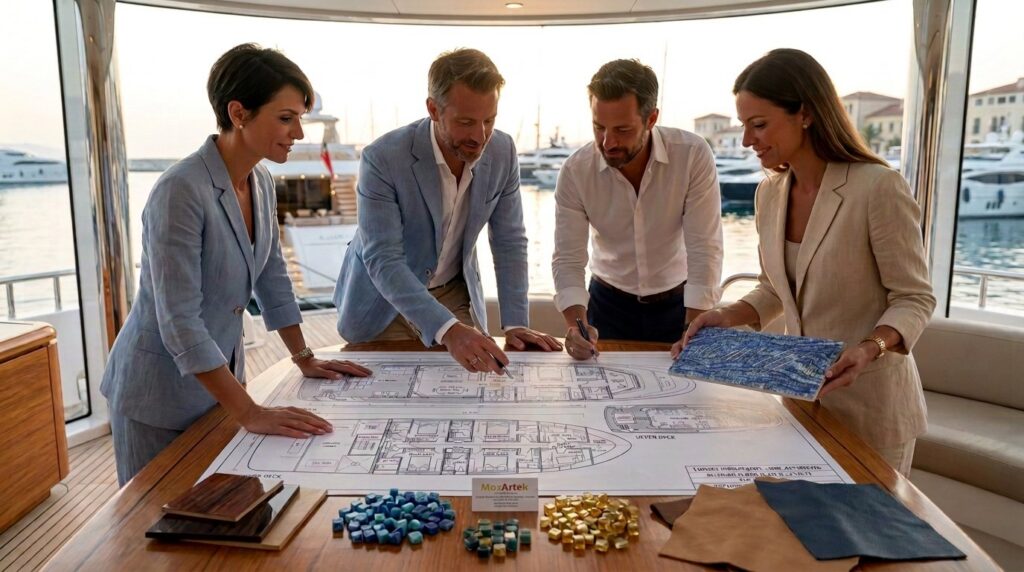
Every superyacht, sooner or later, returns to the yard.
A refit is a certainty in the life of a boat: interiors are stripped out and rethought, systems upgraded, surfaces remade. It is a costly and complex undertaking, and it is also an opportunity that will not come round again for years. And there is one thing, in particular, worth doing right now and almost only now: integrating a permanent artistic mosaic on board.
I say this to owners, yards and yacht designers I meet on this coast: if you are thinking of a work meant to last, the refit is its moment. Not a detail to be added at the end, but a choice to put into the project from the very first meetings.
Why during the refit, precisely
An artistic mosaic is not a painting you hang. It is a work that goes into the vessel, not onto it: it has a thickness, a weight, a substrate, and it must be anchored to the structure like any other permanent element. Doing it while bulkheads are open, systems are exposed and finishes are still to be laid is simple and clean. Doing it afterwards means dismantling what has just been fitted.
During a refit, all the decisions that matter for a mosaic are still on the table: where the weight bears, how much room can be given to the thickness of the work and its substrate, how humidity and vibration are handled, which surfaces are truly suitable. These are the very questions the yard is already asking about everything else. Bringing the mosaic into that reasoning, and not alongside it, is what makes the difference between a work added on and a fully integrated one.
The refit is the ideal window in which a mosaic can become part of the vessel without having to fight against choices already made
There is also a practical reason, which every owner grasps at once. A refit already brings craftsmen, scaffolding, access and protections into play: the organisational machine is running. Folding the mosaic into that machine costs, in disruption and coordination, a fraction of what it would cost to open the boat up again later just for it. The refit is not only the technically right moment: it is also the most efficient.
And there is a return that goes beyond logistics. A refit is done, almost invariably, to renew the value and the appeal of the boat: interiors, technology, comfort. But everything a refit renews will, one day, be renewed again. A mosaic is the one item in that budget that will never go back to being an expense: it becomes a value that stays, and that accompanies the boat throughout its life.
A work designed with the yard, not after it
This is why the best moment to involve us is early, not late. Discussed with the yard and the designer from the first stages of the refit, a mosaic fits within the real constraints of the boat: the weight allowed on that bulkhead, the available thicknesses, the substrates, the curing times of the structures, the moisture levels of the base. These are details invisible to the eye, but they are exactly what makes a work live for decades rather than for a season.
The substrate, in particular, is a component as critical as the tesserae, even though no one will ever see it. Indoors or out, on a wall or a floor, self-supporting or integrated into the structure: every choice changes the materials and the technique. Deciding it in haste, with the works nearly finished, means condemning the work to a short life. In a refit, instead, the right substrate is built together with the rest, on the right foundations.
Coordinating early also means avoiding the classic last-minute conflicts: an air vent running exactly where the work was to go, a thickness no one had allowed for, a substrate that has not had time to cure. When the mosaic is in the project from the start, these problems simply do not arise, and the yard works with an easier mind.
Where a mosaic lives, on board
The opportunities are many, and a refit puts them all within reach at the same moment. The wall of an owner’s suite, a bed headboard, the bottom and edges of a pool or a whirlpool bath, the floor and walls of a spa or a hammam, the bar and the water feature of a beach club, the wall that welcomes guests on a staircase or in an on-board hall: these are all places where mosaic is at its best, because it loves water and the light that water brings with it.
And scale matters. A decorative border in a bathroom is one thing; a work that becomes the visual heart of a space and defines its character is another. The refit is the moment to think big: when the space is open, a work can be given the scale it deserves.
Materials made for the sea, and a surface that lives with the light
For all this to last, the right materials are needed. Venetian glass smalti, 24-carat gold, and certain natural stones are the materials par excellence of high-value artistic mosaic, and they must be chosen with the marine environment in mind: suitable tesserae, technologically advanced mortars, laying done properly. The sea is merciless – salt, ultraviolet light, vibration, thermal swings – and a mosaic built without judgement would not last to the end of its first season. Built well, it resists as few things on board can.
There is, finally, a reason why mosaic feels so at home on the water, and it has to do with light. Each tessera is cut by hand, and its slightly irregular face catches the light and scatters it, instead of returning it flat like an industrial surface. On board, where the sea is never still and the light changes hour by hour, a mosaic does not merely sit on the wall: it answers the water outside. It is an effect no other finish can give, and in a spa or a beach club it becomes memorable.
These are materials that do not go out of fashion, because they do not belong to a fashion: stone was born of the earth over spans of time we cannot imagine; gold and glass have accompanied art for millennia. It is also why a mosaic, centuries later, still seems alive, while almost everything around it on board, sooner or later, ages.
The signature that survives the next refit
There is a symmetry I like in all this. The refit is the moment when almost everything on board is remade. The mosaic is the one thing that, from that moment on, will not be remade again: it will remain when the furnishings change once more.
A refit is also the moment when an owner takes their time to reconsider what their boat truly is. Tastes change, needs change, sometimes even the way of living the sea changes. It is the natural moment to give that identity a permanent form: the mosaic is the point at which that reflection stops being provisional and becomes a mark meant to outlast the one who wanted it.
Everything you fit in a refit is destined for the next refit. A mosaic is not.
And there is more. If it is designed from the start for it, a mosaic can be detached, transported and re-laid: it can follow the owner from one boat to the next, or come ashore, into a residence, when the boat changes hands. It is not a constraint bound to the vessel: it is an identity you carry with you. The condition is a single one, and it is technical: the possibility of moving it must be foreseen when the work is born, not afterwards. One more reason, if one were needed, to talk about it during the refit and not once the works are done.
What to expect when you entrust us with a work during a refit
Working with us during a refit means a precise path, synchronised with the yard’s:
- we study the feasibility of the work and the suitability of the place, with candour: not every surface is ready, and a mosaic meant to last for centuries deserves solid foundations; if they are not there, they are created;
- we agree with you and with the yard the artistic, technical and commercial parameters, and above all the timescales, so that the work is ready when needed;
- we make everything by hand, with materials chosen from suppliers we trust completely, keeping you updated with photographs and films;
- we install with specialised staff and, on delivery, after inspection, the work comes with a certificate of origin, a certificate of guarantee and a maintenance document.
And our works are guaranteed for life: it is how we protect the investment and the desire for uniqueness of those who entrust themselves to us. Mosaic is a slow art that takes months: planning it within the refit’s calendar, and not against it, is what allows it to be delivered on time and without compromise.
Owners, yards, yacht designers: let us talk in person
If you have a refit planned – your own, or a client’s – this is a technical conversation before it is an aesthetic one, and the moment to have it is now, while the project is still open and every choice is still possible.
Our experience began in Italy in 2000 and, since October 2025, has come ashore in Antibes, a short distance from the ports where these refits take shape.
The Monaco Yacht Show is, every year, the place where this world gathers: owners, brokers, captains, yards, yacht designers and the family offices behind them. It is exactly the community with whom this conversation makes sense, and the week of the show is when the market brings it into focus.
I will not be at the MYS this year, but the subject is unchanged – and talking it through calmly is better than doing so in the crush of those days.
If you are planning a refit, your own or a client’s, write to me privately and let us take a little time to talk it over.
Silvia Jencinella
Creative Director and CEO, MosArtek, Maison d’Art de Création de Mosaïque Italienne
Image: MosArtek 2026, Firefly Image 5/stock.adobe.com