
For centuries, the most affluent did not buy art. They brought it into being.
There is an enormous difference between the two, and we have almost forgotten it. For a long stretch of our time, those with means became buyers: they acquired finished works, on a market, often as an investment.
The patron, the one who gives an artist the time and the means to create something that did not exist before, seemed a figure of the past.
It is coming back and, interestingly, it is families, and the family offices that guide them, that are bringing it back, not only institutions.
To buy is not to commission
A buyer acquires a finished object. They choose among what exists, negotiate a price, take it home. Their relationship with the work begins when the work is already complete, and with the artist there is, often, no relationship at all.
A patron does something else. They put an artist in a position to create: they give a theme, a place, the necessary time, the means. In return they receive a work that without them would not exist, and that carries their vision, and their name, into the future.
The buyer owns a work. The patron is part of one. It is the difference between having something beautiful and leaving something that remains.
We remember history through its patrons
Let us look at what has survived. The great mosaics that cross the centuries, those of Ravenna, of the basilicas, of the chapels, do not exist because someone bought them. They exist because someone commissioned them.
The emperors, the bishops and the bankers who financed the mosaics of Ravenna in the sixth century were not making a purchase. They were leaving a mark meant to last longer than themselves, than their palaces, than their empires.
Fifteen hundred years later we are still there looking at them, and of some of those commissioners we know the name precisely thanks to those works.
One example for all. Some of the most extraordinary mosaics of Ravenna were financed by a banker, Julianus Argentarius, who put his own means at the service of the building and decoration of those basilicas. He bought nothing: he made something possible.
Fifteen hundred years later, his name still lives bound to works that millions cross the world to see. Few financial fortunes have left a trace as lasting.
The same holds for the Renaissance. The families that commissioned the works which today define our idea of beauty were not buying finished paintings: they supported artists, gave them chapels, walls, years of work. Their name has reached us attached to those works.
Almost no one remembers who bought. Many remember who brought into being.
The mosaic has always been the patron’s art
If there is an art that cannot be bought ready-made, it is precisely monumental mosaic.
There is no market of mosaics conceived for a place and ready to use. A great mosaic is always commissioned: it is born for a wall, for a space, for a precise light.
It demands time, months of atelier work, and a relationship between the one who desires it and the one who creates it. It is slow by nature, and its slowness is the same that will make it last.
This is why the mosaic is, historically, the patron’s art par excellence. Every great mosaic we admire is the fruit of a commission: someone who wanted that work in that place, and gave masters the time and the means to make it.
It is a gesture that today repeats itself identical to how it repeated centuries ago.
Why family offices are rediscovering patronage
Something is moving among families of great wealth, and those who advise them sense it.
There is a weariness with the accumulation of objects, even precious ones, that remain foreign to those who own them. And there is a more mature desire to leave something that has meaning: not another asset in the portfolio, but a mark that speaks of the family long after the family is gone.
Patronage answers exactly this. It is not abstract philanthropy, nor is it collecting. It is the choice to make a work exist, in a residence, in a headquarters, in a place that matters, and to bind it for ever to one’s own name and one’s own story.
A family office that guides a family towards commissioning is not helping it to buy art. It is helping it to become part of a story longer than its own.
Patronage and speculation look in opposite directions
It is worth saying it clearly, because the two worlds are often confused.
The contemporary art market, for an important part, looks to the short term: one buys hoping the value will rise, one resells, one chases a fashionable name. It is a legitimate game, but it is the opposite of patronage.
The patron does not chase a price. It does not matter to them whether tomorrow that artist will be valued more highly: what matters is that the work exists, and that it remains. Their horizon is not the next quarter; it is the next generations.
Where the speculator wants liquidity, the patron wants permanence.
Those who speculate buy what they will be able to resell. Those who practise patronage create what no one will want to sell.
For a family that thinks in the long term, this is a distinction that changes everything.
It is not about placing capital in an alternative asset; it is about choosing to be, for once, on the side of those who leave something rather than on the side of those who trade it.
Patronage as family identity
There is a final aspect, perhaps the most precious for a family office.
A commissioned work becomes a fixed point in a family’s identity: a chosen subject, a place, a story that is told to the children and that the children will tell theirs. It is not one asset among many: it is a chapter of family history.
Families that last over time do not hold together on wealth alone. They hold together with a shared narrative, with symbols, with places that mean something.
A permanent work of art, wanted and brought into being by the family, is one of those symbols: something that says who we are, that stays in its place while all the rest changes, and that the following generations inherit as a belonging, not as an object.
What being a patron asks, and what it gives
Patronage is not a transaction, and it is well to know this beforehand.
It asks for participation. The patron does not delegate and then collect a parcel: they take part in the birth of the work. They choose the subject together with the artist, follow its making, enter the process. It is a relationship, with the time and the care of a relationship.
In return it gives something no purchase can give: the certainty of having made something exist that was not there before, and that will remain.
The patron does not buy a place in memory: they build it, work by work.
It is a different experience even in the family’s lived life. A bought object enters the house already concluded, whereas a commissioned work enters the family’s life long before it is finished: in the conversations about the subject, in the waiting, in the visits to the atelier.
When it is complete, it is not only theirs: it is a little their child too. And it is this bond, not the value, that makes it an inheritance.
A necessary clarification
I add a note, so that it is not missing. In some legal systems the support of the creation and conservation of art finds recognition, and cultural patronage is its best-known example. These are real aspects, but they depend on the jurisdiction and must be verified with the family’s advisers.
The families we remember did not commission for an advantage: they commissioned to leave a mark. And it is still the best reason to do so.
The long term as true luxury
We live in the age of the immediate. One buys with a tap, receives the next day, replaces at the first sign of boredom. In a world like this, the rarest thing, and therefore the most authentic luxury, is what asks for time and lasts over time.
Patronage is exactly this: a slow gesture in a fast world.
It does not give an immediate gratification; it gives one that grows and consolidates over generations. It is the opposite of all that the market accustoms us to desire, and it is perhaps for this reason that the most aware families are rediscovering it: because it is the only form of wealth that time does not consume but rather makes more precious.
For the family offices that want to lead, not follow
There is a role, today, for those who advise great families, and it is not that of procuring one more object of prestige. It is that of opening a different possibility: making the family a patron, and a permanent work its mark in time.
The most enlightened family offices are already doing it. They bring back to the centre a very ancient tradition and put it at the service of those who have the means to leave something that lasts: not an asset to resell, but a cultural inheritance to pass on. It is a way of guiding a family, instead of merely following its requests.
Our experience was born in Italy in 2000, in the land where mosaic and patronage walked together for two millennia, and has come ashore in Antibes.
If you are advising a family ready to pass from buying art to bringing it into being, that is the conversation worth opening. I am at your disposal to begin it together.
Silvia Jencinella
Creative Director and CEO, MosArtek, Maison d’Art de Création de Mosaïque Italienne
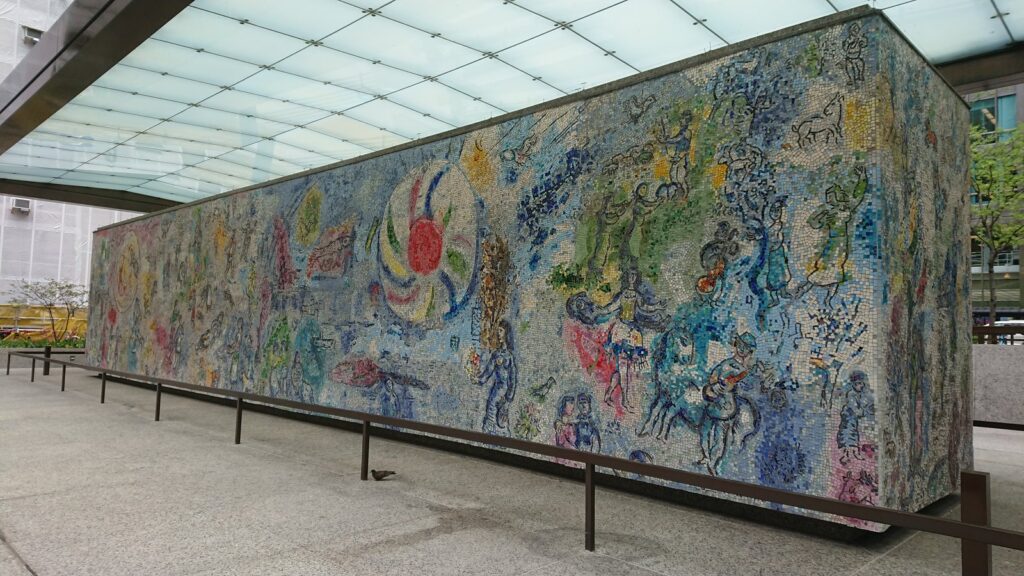
Image: Four Seasons by Marc Chagall and Mosaic Master Lino Melano, Chicago – Saalebaer, CC0, via Wikimedia Commons