
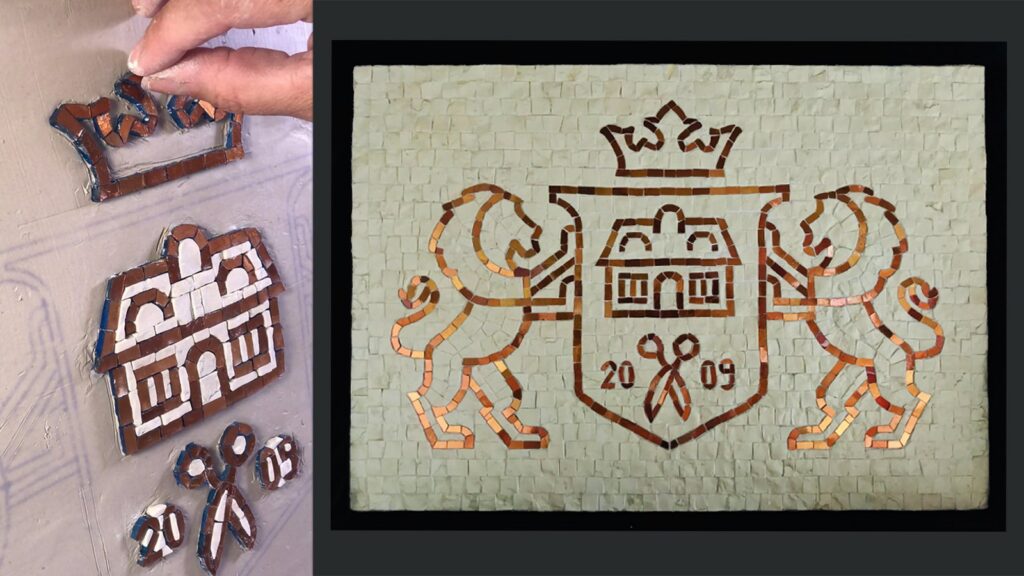
In almost every corporate headquarters with an established identity well known to its public, there is at least one wall that at a glance ought to speak clearly of «who and what the company is».
Usually, a company logo made of industrial materials or, at most, a painting is hung there.
When the board or executive leadership changes, tastes change and the painting is replaced with another. Or the corporate logo is made from an object that recalls the brand only visually, but contains no exclusive materials.
The impact on the observer is conscious brand recognition, but on the whole, seen one, seen them all.
What can truly awaken the attention and slow the step and mind of that strategic client when they enter your corporate reception hall, compelling them to pause and reflect on what they are looking at?
Forward-looking enterprises are beginning to make a different choice. Instead of hanging a fleeting piece of art, they commission one that remains and commands the gaze.
Instead of buying, they commission; they choose the most durable medium humankind has ever produced: bespoke artistic mosaic.
Corporate Identity Is Not Replaced Every Five Years
A company expects its headquarters and offices to project an image worthy of its brand, to make a positive impression on clients and partners, and to help consolidate or, even better, elevate its stature.
An image built on ephemeral, fragile, or all too commonplace elements must be reconsidered frequently; it conveys limitation rather than solidity.
The identity of an enterprise built to last deserves an equally enduring mark, one that makes an impact and delivers a precise message: «I am exclusive».
It is the very same reasoning that has guided great institutions for two thousand years.
The monumental mosaics of Greece, Rome, and Byzantium have reached us through earthquakes, fires, devastation, erosion, and vandalism, and still give the impression that they will endure for ever.
That was the mastery of our predecessors, architects and mosaicists. The question I always ask is: why should an enterprise thinking in terms of decades or more not have the very same ambition?
Your Headquarters Speaks of You
A headquarters is not merely a place where people work. It is a visual discourse, a message addressed to everyone who enters: clients, partners, investors, journalists, and emerging talent to be attracted.
Just as a house «speaks» of its master, a corporate headquarters speaks of the enterprise through the spaces, materials, and works it chooses to display.
The trouble is that much of that discourse is entrusted to predictable or commonplace elements.
A permanent mosaic changes the nature of the message: it says that the company reasons in decades, not in quarters, and is prepared to leave a mark destined to outlast those who commissioned it.
It is the kind of statement competitors cannot copy on the cheap.
Translating a company’s identity into visual form, after all, is no simple matter.
Almost always, those who contact us have a clear idea of their values and perhaps a slightly vague notion of how to represent them: they bring examples, explaining themselves through analogies.
Our task is to listen to both explicit requests and unspoken intentions, transforming them into a concrete proposal, coherent with the brand and the architectural space that will host it.
For us, it is a work of translation before it is even one of execution and delivery.
The Reassessment of Workspaces: From Desire to Necessity
The strong desire to re-evaluate and enrich workspaces was felt acutely in the period following the 2020-2021 Covid pandemic.
I took part, online, in an international design event. The participants and speakers were predominantly interior designers hired to transform the work environments of those who spent at least eight hours indoors within a few square metres, executives included.
Moving from bland, colourless spaces to environments structured with attention to emotional wellbeing.
Two main conclusions were highlighted:
- a setting devoid of stimulating visual input causes mental fatigue; being confined by circumstances, first in remote working and then upon returning to corporate offices, demonstrated the vital importance of working in a welcoming environment. The mood improves, and consequently everyone’s performance, integrating seamlessly with the corporate identity in which people feel an active part of the mission.
- re-evaluating the setting with bespoke works that speak directly and clearly of the brand: a breath of fresh air that does not go unnoticed by strategic clients returning to the enterprise. They stop, observe, appreciate, and realise that your organisation did not yield to the crisis, but rose with renewed strength.
A corporate emblem in artistic mosaic, exclusive and entirely handmade, commanding a feature wall in the reception hall, inspires deep admiration in the minds of those vital clients.
Buying or Commissioning
There is also an argument that speaks directly to the balance sheet.
A hung painting is an object that can be bought and sold; its value lives on the open market, and on the market it fluctuates.
A commissioned mosaic is something else: it is integrated into the building, it is unique, and it is bound to the identity of the person or enterprise that wanted it – a brand capital built over time that time consolidates rather than erodes.
A mosaic commissioned today will still be in the headquarters a decade and more from now, telling the history of the brand. Few other art investments can claim the same.
I remember well a client who, some twenty years ago, upon delivery of his corporate emblem in natural marble artistic mosaic, remarked with a smile: «Look, our brand already existed in Roman times!». He was joking, of course, but not entirely!
There is also a cultural dimension that discerning enterprises are rediscovering. Commissioning a work, rather than buying it, means returning to being patrons in the fullest sense of the term, just like the great institutions and patrons of the past.
You do not acquire an already existing object: you bring into being something that did not exist before, bound for ever to the name of the organisation that commissioned it. For a brand building its reputation over the long term, it is one of the strongest statements it can make.
Scale and dimension amplify everything: in a corporate hall, a boardroom, or on the reception wall welcoming visitors, a monumental mosaic is not merely one ornament among many, but the visual focal point and centre of gravity of the entire space.
It is not nostalgia; it is strategy.
In an era where almost everything is replicable, reproducible, and replaceable, possessing something that is not becomes a rare advantage.
A corporate brand that displays a unique, permanent work in its headquarters says something that no advertising campaign can say in its place.
Industrial or Artistic: They Are Not the Same Thing
Here a clarification is essential, because mosaic is not all the same. In high-traffic public spaces – airports, underground stations, shopping centres – industrial mosaic is often used: regular, machine-cut tiles that are laid quickly and withstand the passage of thousands of people.
The solution is versatile and valid where the priority is resistance and uniformity. But it is rarely a precious, refined, and bespoke execution.
Artistic mosaic is an entirely different story: the tesserae are split by hand with the hammer and hardie; every surface is uneven and catches the light, making the whole work as precious as a jewel.
For the identity of an enterprise that wishes to distinguish itself, this is the path.
Choosing between the two is not a matter of price, but of purpose. Where heavy footfall must be resisted, industrial tiles do their job; where you need to declare who you are, only artistic mosaic possesses the right voice.
The Materials of Permanence
None of this happens by chance.
It rests on materials of a quality most people never encounter. The smalti of artistic mosaic are still produced by hand in thousands of shades, from closely guarded recipes, in a handful of specialised furnaces mostly in north-eastern Italy.
To these are added natural stone, shaped by nature over spans of time we can barely imagine, and 24-carat gold that lends the work its depth and elegance.
Cut by hand, tessera after tessera, these materials are literally made to outlive the buildings that house them.
It is not an aesthetic indulgence: it is the reason why a mosaic, centuries later, continues to feel alive.
Why Execution Quality Is Everything
There is a misunderstanding that proves costly. Many assume that the word «mosaic» alone guarantees longevity, but that is not so.
Early in my career, a restorer of ancient works told me that for a modern mosaic, lasting ten years is enough: an idea I have never accepted.
I have seen mosaics bought online or from hobbyists begin to degrade after a few months, with collapsed mortar and entire sections falling away at the first vibrations of transport.
For an enterprise, a work that degrades rapidly is not merely a financial loss: it is brand damage, the exact opposite of what was intended.
Durability depends heavily on the scientific understanding of materials, the chemistry and physics of combined elements, and the professionalism gained through decades of practice and refined technique.
That is why, when an enterprise entrusts its image to us, the first commitment we make is not aesthetic, but technical: ensuring the work endures.
An image built to last cannot rest on fragile execution.
What an Enterprise Can Expect When Entrusting Us with Its Image
Entrusting us with the image of a headquarters means embarking on a structured journey.
We first assess the architectural feasibility of the work and the suitability of the setting, with absolute candour: not every corporate site, however prestigious, is ready to receive such a work, and a mosaic destined to last for centuries deserves to start on solid ground.
If that solid ground is not present, it must be created.
We then agree upon all parameters – artistic, technical, and commercial – and the project schedule.
The work is created from an agreed design, which may originate from us or from the company’s architect or designer, and is cut and assembled entirely by hand using materials of authenticated provenance.
It is a deliberate, slow art that requires months; throughout the creation, we keep the client updated with photographs and video documentation.
Installation is carried out exclusively by specialist personnel. Upon delivery and inspection, the enterprise receives a certificate of origin, a certificate of guarantee, and a maintenance document.
Our works are guaranteed for life: it is our way of protecting the investment the enterprise places in a mark destined to represent it for generations.
It is a process designed to give decision-makers the certainty required of any major capital investment: knowing precisely what is received, how it is made, and how it will endure over time.
The 3 Characteristics of the Legacy of Choosing Mosaic
An enterprise that commissions a permanent mosaic chooses far more than a decoration:
- it signals to clients and partners that it thinks on a grand scale and for the long term;
- it leaves a lasting mark for successors, a steadfast anchor of identity;
- it tells future generations that someone before them took the care to build something destined to endure.
Few decisions, for a comparable investment, say as much.
The difference between furnishing a space and leaving a legacy.
Enterprises that understand this no longer merely hang a painting: they commission something their successors will still find standing.
Does your enterprise, group, or corporation have the ambition to stand apart?
I can help you achieve this. Contact me and let us discuss it; it is one of my favourite conversations.
Our expertise began in Italy in 2000, and since October 2025 has come ashore in Antibes.
Silvia Jencinella
Creative Director and CEO, MosArtek, Maison d’Art de Création de Mosaïque Italienne
Image: MosArtek2026