
In Nazareth stands one of the most important churches in the Christian world. The Basilica of the Annunciation rises over the place where, according to tradition, the archangel Gabriel announced to Mary the coming of Jesus. It is a building meant to speak across centuries, to millions of pilgrims, in a language that does not fade.
When such a place decides how to adorn itself, the choice is never casual. And over many years the Basilica has been decorated, piece by piece, with works given to it by Catholic communities from more than fifty countries, each nation offering an image of the Virgin as she is venerated at home. These gifts are, overwhelmingly, mosaics.
That fact deserves a moment’s thought. Of every medium available to the wealthiest and most sophisticated institutions on earth, the one chosen again and again for a work that must last is the mosaic. I want to explain why, because the reasoning that guides a basilica is the same reasoning that should guide anyone commissioning permanent art, whether for a residence, a headquarters or a yacht.
I can explain it from the inside, because our atelier was entrusted with Switzerland’s contribution.
A gift that was missing
The story began with a Franciscan friar. Father Gottfried Egger, the Franciscan Custos of the Holy Land for Switzerland and Liechtenstein, was on pilgrimage in Nazareth when a thought struck him. Something was missing. Among all those nations represented on the walls of the Basilica, there was nothing from Switzerland, home to one of the largest and best-loved Marian sanctuaries in central Europe: the shrine of the Black Madonna of Einsiedeln. «Something is missing here, something has to be done», he said.
And he decided to do it.
Knowing our work, Father Gottfried commissioned our atelier, at the beginning of 2014, to create the piece that would carry Swiss devotion to the Holy Land. The subject was set: the Black Madonna of Einsiedeln, Our Lady of the Hermits, the most important Marian icon in Switzerland. The dimensions were fixed at seventy by two hundred centimetres, the same as the other works in the church. The dedication would be written in the four languages of the confederation. Beyond that, we were left free in our choice of colours, methods and materials.
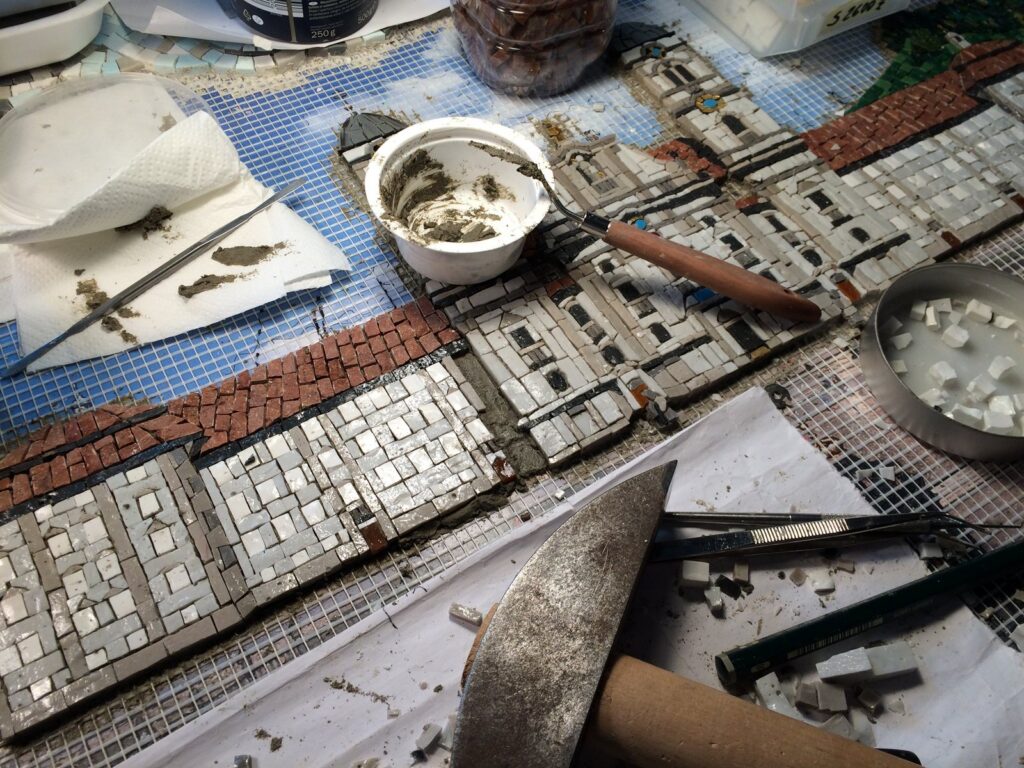
We set to work. The finished mosaic took nine hundred hours, and it was ready on time. Before it left Switzerland, it was brought to the sanctuary of Einsiedeln itself, where, on Palm Sunday, Abbot Urs Federer blessed it before a church full of the faithful. It remained on view through Holy Week and Easter Week, and then it was entrusted to a firm that specialises in moving great works of art, and carried to Nazareth without a scratch.
The morning of the inauguration
On 24 April 2015 the work was inaugurated. The Swiss Ambassador to Tel Aviv, Dr Andreas Baum, was present, together with Father Gottfried, the Franciscan community and a gathering of Swiss pilgrims. The morning was warm and bright. The mosaic, set facing east, caught the full strength of the rising sun and blazed with light. I was standing beside it, and I was almost blinded.
The Ambassador spoke, and his words have stayed with me ever since, because they say more about the nature of mosaic than any technical argument I could make. He looked around at the many works in the church, all showing the Virgin, all different, and he said that they were like individual stones in the great mosaic that is the church itself: separate, distinct, yet forming one image of hope and reconciliation. In a region too often defined by its conflicts, he saw in that wall of many nations a model of how difference might become enrichment rather than threat.
That is the deeper reason an institution reaches for mosaic. A mosaic is, by its very nature, a coming together of countless small, individual pieces into a single meaning. It is the perfect image of a community, of a shared faith, of many becoming one. No single painted canvas can say that in the same way, because a canvas is one gesture by one hand. A mosaic is thousands of decisions, thousands of fragments, held in a unity that is visible to the eye.
Years later, we still receive warm messages from people who have seen the work in Nazareth. That, too, is part of the answer. A mosaic does not merely survive; it continues to speak.
Durability is a form of respect
There is a plainer reason as well, and it is the one an architect or a facilities director will grasp at once. A basilica does not want to redecorate every generation. It needs a medium that will hold its beauty across centuries, in a public setting, exposed to light and crowds and time. Mosaic is that medium.
The evidence is everywhere in the ancient world. The great mosaics of Greece, Rome and Byzantium have come down to us through earthquakes, fires, devastation, erosion, vandalism and endless biological attack, and they still give the impression that they will last for ever. That was the skill of our predecessors, the designers and the mosaicists who came before us. The question I always ask is: why should we not have the same ambition today?
For me this is not a rhetorical point. Early in my career I argued with a restorer of ancient works who told me, to my astonishment, that a modern mosaic only needed to last ten years. I could not accept it. I have spent years testing materials, running resistance trials, narrowing my choices until only the finest options remained, precisely so that my works can last as long as the Roman and Byzantine mosaics do. To build something meant to be permanent and to build it carelessly is a contradiction. Durability is a form of respect, for the client, for the setting and for the generations who will inherit the work.
I should be honest that this is not automatic. A mosaic made without this care can betray its promise quickly. The specialists who restored the contemporary mosaics of the Parco della Pace in Ravenna recorded how such works, surprisingly but predictably, began to show the first signs of decay very early, and how most of those problems came down to structural defects and to the materials chosen for the making and the assembly. As the director of that project observed, many artists believe they bear no responsibility for the preservation of their work, because their whole attention is fixed on the creative act. That is exactly the attitude a basilica cannot afford, and neither can any serious client. The choice of medium is only half the promise. The other half is the professionalism with which it is made.
The materials of permanence
None of this happens by accident. It rests on materials of a quality that most people never encounter.
The glass used in artistic mosaic, the smalti, is still made by hand, from closely guarded recipes of silica, oxides, fluxes and stabilisers, by a few specialised furnaces, mostly in the north-east of Italy. It exists in thousands of shades. To understand the scale of that palette, consider the Vatican Mosaic Studio, which I visited regularly in the early years of this century, when it was directed by the late Professor Dario Narduzzi. He once took me to see the studio’s historic archive. In 2004 it held thirty-six thousand different shades of smalti, including originals from the sixteenth century. «No laboratory in the world», he told me, «can have a collection so vast. It is an enormous investment, one that only the Vatican, over the course of centuries, could afford.»
Add to the glass the natural stone, formed by the earth over unimaginable time, and the gold leaf that gives Byzantine work its spectacular depth, and you have materials that are, quite literally, built to outlast the buildings that hold them. Cut by hand, tile by tile, they catch the light and make it move. This is why an institution that thinks in centuries chooses mosaic. It is choosing matter that keeps faith with time.
What a basilica knows
So when I am asked why the wealthiest clients on this coast should consider a permanent mosaic for a home, a company headquarters or a superyacht, I often begin with Nazareth. Because a basilica had the same choice everyone has, between the temporary and the lasting, between decoration and legacy. It chose mosaic, as institutions have chosen mosaic for two thousand years, because it wanted something that would still be speaking, still be blazing in the morning sun, long after everyone who made it had gone.
That is the standard we hold ourselves to at MosArtek, an atelier that began in Italy in 2000, spent many years in Switzerland, and since October 2025 has made its home on this coast, in Antibes. And it is the conversation I would be glad to have with anyone here who is thinking not only of the next season, but of the next century.
Silvia Jencinella
Creative Director and CEO, MosArtek, Maison d’Art de Création de Mosaïque Italienne
Image: MosArtek